Table of Content
Some kit house companies continued after World War II, but most homebuyers flocked to the new, inexpensive tract house subdivisions springing up across the country. Ltd. – a branch plant, of the Michigan-based Aladdin Homes, the largest kit home seller in Canada, its Canadian headquarters were located in the Canadian Pacific Building, in Toronto. They operated across the whole of Canada, from 1905 to 1952. They were truly pre-cut, and need very little skill to assemble. They also featured high-quality lumber, and the company offered a refund of $1 for each knot found in a kit. In addition, with some companies, homebuyers could choose the quality of materials.

The 1950s produced the most beautiful kitchens one could ever imagine. Austin Memories, accessed 5 July 2011 During World War I, the Austin Motor Company imported 200 pre-cut Aladdin bungalows to house its influx of war workers, in a development still known as Austin Village in Birmingham, England. Other smaller providers of mail-order kits included The B.C. Mills Timber and Trading Co., United Grain Growers, the University of Saskatchewan, and the Manitoba Agricultural College.
Sears Catalog
Sales were down, and there was excess inventory languishing in warehouses. Kushel is credited with suggesting to Richard Sears that the company assemble kits of all the parts needed and sell entire houses through mail order. That year, the Aladdin Company of Bay City, Michigan, offered the first kit homes through mail order.
Thousands of formerly ineligible buyers were absorbed into the new-home market. For more than 30 years, the Chicago-based retailer was the king of catalog Sears houses. Like the Standard Addition in Carlinville, neighborhoods of Sears houses still hold a sense of identity and community. Due to reviews by homeowners then and now, it would appear that Sears Modern Homes are just as appreciated now as they were then. According to a review written by Mary Ann O'Boyle of Takoma Park, Maryland, her Sears home feels "unabashedly American, the kind of house you see in movies about the good old days" and "allows me to connect with the past". Another homeowner, Erskine Hogue Stanberry, states that his Saratoga model was the "first house in Chelsea to have electric lights" and that they "are using the original plumbing and wiring".
When the Sears Catalog Sold Everything from Houses to Hubcaps
In addition to houses, the 1908 Sears catalog offered a kit schoolhouse with the model name "Schoolhouse No. 5008". The two-story schoolhouse was priced at $11,500 and its design included six classrooms, a library, an auditorium, and a superintendent's office. 1908 was the only year the schoolhouse appeared in the catalog.

National and regional competitors in the catalog and kit home market included Aladdin, Bennett, Gordon-Van Tine, Harris Brothers, Lewis, Pacific Ready Cut Homes, Sterling and Montgomery Ward Homes. Sears Modern Homes offered the latest technology available to house buyers in the early part of the twentieth century. Central heating, indoor plumbing, and electricity were all new developments in house design that “Modern Homes” incorporated, although not all of the houses were designed with these conveniences. Primarily shipped via railroad boxcars, these kits included most of the materials needed to build a house.
Sears house kits become a big seller.
Goodwall Sheet Plaster was sold in the pages of the Sears Modern Homes catalogs. This was a “fireproof” product that was much like modern sheetrock. “The Sears Homes of Illinois” has more than 200 color photos of the most popular designs that Sears offered and can be very helpful in identifying Sears Homes. Turquoise refrigerators, canary yellow cabinets, stainless steel countertops, pink built-in ranges – who could possibly gaze upon these gorgeous mid-century miracles and not swoon?

Sears offered 370 models over the 32 years it sold houses by catalog. In the early years, the models were identified with numbers. After several years, Sears also began assigning names to the various models. Some models were offered with variations, the most common of those being expanded floor plans and additional finished living spaces. Sears houses could also be ordered with reversed floor plans. While the vast majority of models were for single-family house designs, Sears offered some duplex house designs and even a few larger multiple-family buildings.
Identifying Sears Modern Homes
The company’s first 44-page Book of Modern Homes and Building Plans, issued in 1908, brought an immediate and enthusiastic response. He was a merchandising genius credited with inventing Sears, Roebuck and Company’s Modern Homes program, which provided well designed, well constructed, economical shelter for perhaps 75,000 American families between 1908 and 1940. Today, buyers are still snapping up vintage Sears houses just as eagerly as they did 80 years ago. Carlinville, Illinois, with 149 in the Standard Addition neighborhood as well as several other Sears houses elsewhere in the city. Carlinville is said to have "the highest concentration of contiguous Sears homes in the nation." The kit-home angle "made it more appealing by adding to its character," Ms. Mackler says.
By the middle of the bungalow era, a host of companies offered pre-cut kits, which would be shipped by rail for on-site construction. Not only lumber but also everything down to the nuts and bolts, and even paint, were included. Leading sellers included Keith’s, Aladdin, Sears, Harris Brothers, Montgomery Ward, and Gordon–Van Tine. It's a house whose blueprints and building supplies were ordered from a specialty Sears catalog, and all of these supplies were shipped, by rail , to the homeowner .
Some builders and companies purchased houses directly from Sears to build as model homes, speculative homes, or homes for customers or employees. Lindal Cedar Homes, based in Washington state, has sold about 50,000 kit homes since 1945. The models start at about $100,000 and range in size from 700 square feet to 25,000 square feet. What has changed, says vice president of marketing Signe Benson, is that the younger clients now want modern instead of traditional designs. And most of her company’s customers hire contractors to build the homes.

Sears homes can be found across the continental United States. While sold primarily to East Coast and Midwest states, Sears homes have been located as far south as Florida and as far west as California.
At Greenlawn Cemetery, near the Hampton Roads waterfront in the Newport News, Virginia, area, the cemetery office building is a 1936 Sears Modern Home. Many of the famous designs were commandeered from other sources and/or purchased from architects but given just enough change to be advertised as their own. Later on in the Modern Homes timeline, Sears had in-office designers but titled them as "experts" rather than actual architects. The largest and one of the most expensive Sears models was the Magnolia.
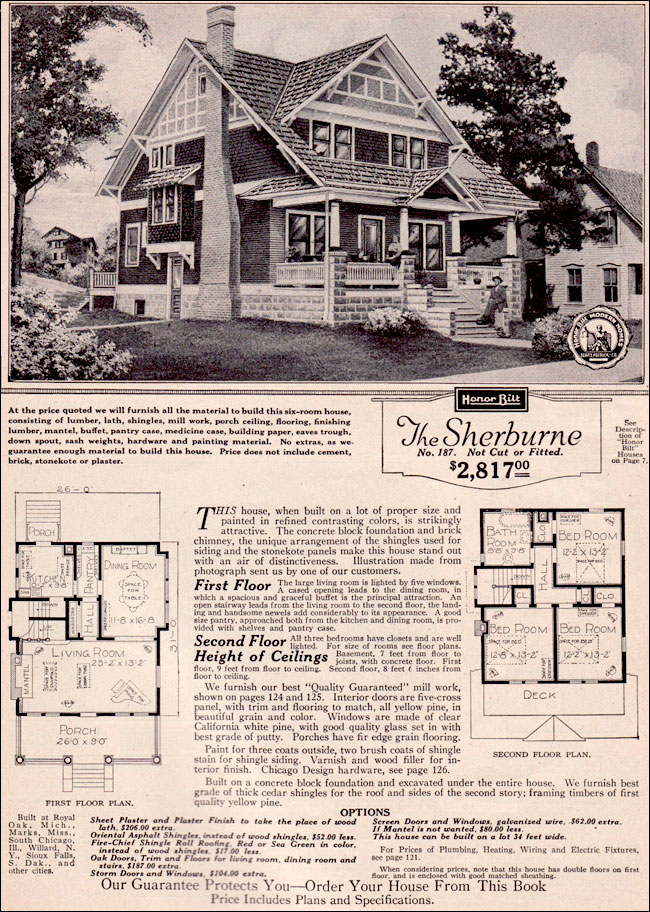
Sears provided some customization (mirror-reverse plans, for example), a book-length instruction manual, and 10,000–30,000 pre-cut and -fitted framing members and elements. Plumbing, electrical, and heating equipment could be purchased separately, also from Sears. Local general stores were typically high-priced and offered little selection. The Sears catalogue gave America’s farm families a lot of options at a lower cost and often included delivery. Sears’ simple, warm and customer-service-centered approach helped it stand out among mail-order competitors like Montgomery Ward and Hammacher Schlemmer.
Its 130-year history embodies the rise and fall of American consumer culture. Most of the houses had two or three bedrooms, although some had four or even five. The majority had only one bathroom, and some, especially in the early 20th century, had none, since many rural and even some suburban areas lacked piped-in water and sewers or septic fields. By the 1930s, though, quite a few of the larger houses had two or a full bath and a “powder room.” Buyers had their choice of two different outfits, depending on their tastes and pocketbooks and on the requirements of the bathroom layout. Featured in catalogs from 1912 to 1929, the Westly was one of Sears’ most popular designs.
Alternatively, customers could opt for “sheet plaster” at considerably greater expense. For roofing, they could choose between red cedar shingles or the costlier “Oriental Asphalt” shingles, which came with a 17-year guarantee. Kushel’s boss, Richard Sears—himself no slouch at merchandising—recognized the plan’s potential immediately and so did the buying public. Sears’s reputation for quality, low prices, and reliability, carefully nurtured since the company’s founding in 1886, was like money in the bank for its customers.


No comments:
Post a Comment